Chapter 1I bounced the red ball and scooped up all ten silver jacks. One jack fell.
“Put those toys away, Abigail,” Mama said. “We’re ’bout ready to leave. C’mon, now.”
“I don’t wanna go,” I told her, but that wasn’t exactly true, because though part of me was sad about leaving, I was also tingling with excitement about moving.
Daddy grabbed the last box and grinned. “It’s going to be a wonderful adventure, Abigail, remember?”
I dropped the ball and jacks into their bag, glanced around the room one more time, butted the creaky screen door open, and stepped outside into a clear, sunny day.
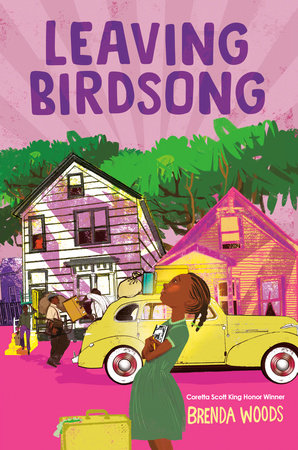
Today, Mama, Daddy, and I were leaving Birdsong, the small South Carolina town that had been our home. The place where my friends and I had dillydallied around the marshlands, chasing after swamp rabbits and green tree frogs. Where, in a one-room schoolhouse, I’d learned reading and writing and arithmetic. Where I’d recited Bible verses and psalms in Sunday school and where, afterward, we’d sometimes wander down the road to a country shack to listen to our neighbor Old George sing and play his banjo.
As I stood there on the porch, recalling those happy times, I felt a longing to stay and got teary-eyed.
Our suitcases and anything else that would fit were crammed into the car, and some of our neighbors and friends had gathered to say their goodbyes.
Even Gabriel showed up with his mama and daddy to see us off. Gabriel Haberlin was the white kid Daddy had saved from getting hit on his bicycle by a speeding car. And afterward Gabriel had gotten my daddy a job as a mechanic at the service station owned by his father, Jake. Most Colored people in Birdsong didn’t own an automobile, but we did, and Gabriel’s father was the reason why.
“There aren’t enough words to thank you for saving our son, Mr. Hunter,” Gabriel’s mother, Agatha, told Daddy.
“We’ll be forever grateful,” Mr. Haberlin added, “and I sincerely hope things work out for y’all up there.”
Daddy nodded. “Me too. And thanks again for all your kindness, Jake . . . and letting me have this car.”
Mr. Haberlin patted Daddy’s shoulder. “It’s the least I could do, Meri. Plus, you were the only one who could fix this old clunker. I was ready to send it to the junk heap. But then you came along and worked your mechanical magic.”
Daddy chuckled.
We were about to go when Gabriel walked up to me, smiled, and said, “Just wanted to say bye, Abigail.”
I stared into the eyes of the boy who’d become my friend, the boy Daddy claimed was an old soul. “So long, Gabriel,” I told him, then climbed into the back seat of the car.
The tank was filled up with gas, and my mama and daddy seemed filled up with hope. Daddy started the car, and our journey began. Another Colored family heading north, picturing a brighter future, yearning for a better life.
Chapter 2As the car bumped along the country roads, jostling me now and then, I wished that this “wonderful adventure” were a book that had already been written. That way I could flip to the last pages and find out how our story was going to end. But it wasn’t, so I sat there wondering about things to come, my questions multiplying.
Detroit, Michigan, a city that Mama and Daddy claimed was full of opportunity for Colored people, was our destination, but first we took a quick detour to say goodbye to my nana.
As soon as we stepped inside her small white clapboard house, my mother, Phoebe, started her usual begging. “Please come with us, Mama.”
“How many times do I have to tell you no, Phoebe?”
I leaned into Nana’s shoulder. “Please.”
She smiled and shook her head.
So Daddy gave it a try. “Got a good-paying job waiting for me up there in one of the automobile plants, Justina. You really should think again about coming up to Detroit. You wouldn’t have to work hard anymore.”
Nana sighed. “Carolina’s where I took my first breath and where I plan to take my last. This farm isn’t much, but somehow we always made do. Never had to ask anyone for anything. Plus, before my dear husband died, he made me promise I’d never sell this parcel of land. And I hear there’s a plot of good farmland for sale nearby. Maybe you should think about buying it and making a living here, Meriwether.”
“Thanks, Justina, but you know farming’s never been in my blood. Even way back, when I was helping my daddy work his land, it was always machines that interested me. I wanted to—no, I
needed to—understand how things worked. And after being in the army, working on those tanks inside and out, I realized I have a talent for fixing things. And now I’ll be able to use that talent up North.”
Daddy’s face was lit up the way it usually was whenever he talked about his time fighting overseas with the all-Colored 761st Tank Battalion, helping to defeat the Nazis and win the war.
Then, as if clouds had suddenly appeared, the light in his eyes vanished. He stared straight at Nana and said, “But it’s not just about the money or the work, Justina. There are other reasons we’re leaving the South. Being over there in Europe allowed me to experience what real freedom feels like. There were no signs telling me where I wasn’t welcome—not on the trains or in the restaurants. And nobody calling me
boy.” He paused for a moment, glanced at each of us, and added, “Lemme tell y’all something about real freedom . . . it sure tasted sweet.”
“I’ve never known it myself, real freedom, that is,” Nana said, “but I can imagine it tasted better than a chunk of honeycomb.”
Daddy nodded in agreement. “You’re absolutely right, Justina, it was sweeter than honeycomb.” Then his eyes landed on me. “Plus, we want better for our girl. Better than the South has to offer.”
“I understand, Meriwether, I sincerely do. Y’all have some very good reasons for leaving, and I hope it’ll bring the peace and blessings you’re hoping for. As for me, I think I’d be scared to live in a big city up North. From what I’ve been told, there are too many fast-talking folks wearing flashy, store-bought clothes, all stuck living together like sardines in a can. And cars speeding every which way and smoke coming from all those factories. Is the sky even blue up there?”
Daddy laughed. “I’m sure it is, Justina.”
Nana grinned. “Betcha it’s not Carolina blue.”
I chimed in, “When you come to visit, you can see for yourself, Nana . . . You will come to visit, won’t you?”
She patted my hand. “Of course I will, Abigail.”
Like me, Nana loved books. We often spent hours sitting quietly side by side, reading. Whenever I talked about becoming a writer someday, she never called it foolish nonsense the way some people did. And the way she listened to me read the stories I wrote in my school notebook made me feel good inside.
Mama yawned and stretched, got up, and said, “Goin’ outside to have a look around. Likely it’s the last time I’ll be seeing this old house for a while, and I want to hold its memories close to my heart.” When she stepped outside, Daddy followed her.
Then Nana, as if something suddenly dawned on her, went to a shelf, picked up a book, briefly thumbed through it, and said, “I want you to have this, Abigail. It’s a journal—a journal I started writing in many years ago, when I still had dreams about writing a book of poems someday. Except for the first few pages, it’s blank.”
“You wanted to be a writer too?”
She nodded. “A poet.”
“I never knew about that, Nana. Why’d you stop?”
She sighed. “Life . . . took me, Abigail.”
“Took you where?” I asked.
Her eyes darted around the room. “To right here where I am. It’s as if I was riding a strong-willed mule, and whenever I grabbed ahold of the reins and tried steering it in another direction, that stubborn old mule led me right back to the path life had already chosen for someone like me, a poor country Colored girl who never made it past the fifth grade.”
“Maybe you oughtta keep it, Nana, to write more poems.”
“No, it’s yours now, Abigail. Even though I won’t be with you on this journey y’all are gonna take, if you write about it, maybe you’ll share some of it with me later, and it’ll be like I was right there beside you. This should also help to make you a fine observer of life, and if there’s one thing a good writer needs to be, it’s a fine observer.”
“What’s a fine observer?”
“A person who watches people, places, and things and pays very careful attention to what they see and hear,” she replied, then handed me the journal.
“I think I can learn to do that,” I told her as I caressed the front cover.
“It’s leather bound,” she proudly said.
“It’s beautiful. Thank you, Nana.”
“And, Abigail?”
“Yes ma’am?”
“Promise me that you’ll finish your education so that old mule that took me won’t have any say-so over where you belong. Having an education will put you in charge.”
“Yes, Nana, I’ll make sure to.”
“And write me a letter as soon as you can. Promise?”
“Promise.”
I studied my nana, trying my best to memorize her: the plaited gray hair, her pleasant bronze face, and her tender eyes, which, whenever they met mine, always shone with affection.
And at that very moment, I discovered the ache that comes from having to leave someone you love very much, and a twinge of sadness pricked my heart.
-As soon as Mama and Daddy came back inside, I waved the book for them to see. “Nana gave me her journal to write in—she says it’ll make me a fine observer of life!”
Their happy faces beamed.
Nana, Mama, and I soon got busy in the kitchen, preparing food for the long trip. We packed bread and biscuits, baked chicken and ham sandwiches, boiled eggs, roasted peanuts, and ripe peaches, and filled jelly jars with water, lemonade, and sweet tea. Then it was time for us to leave.
As we said our goodbyes, Nana stepped toward me, tugged on one of my braids, and hugged me tightly. She didn’t say a word. She didn’t have to. Some things can be said without words. Love is one of them.
Copyright © 2026 by Brenda Woods. All rights reserved. No part of this excerpt may be reproduced or reprinted without permission in writing from the publisher.