Download high-resolution image Look inside
Listen to a clip from the audiobook
audio pause button
0:00
0:00

Nothing But Fun in Noisy Village

Illustrated by Mini Grey
Look inside
Listen to a clip from the audiobook
audio pause button
0:00
0:00
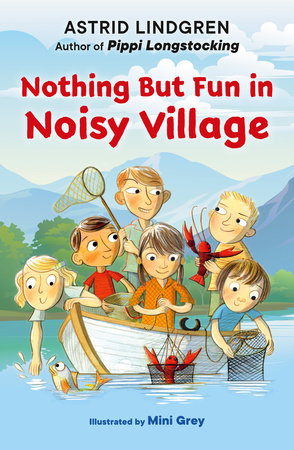
The final book in the beloved Noisy Village trilogy from Pippi Longstocking author Astrid Lindgren!

Noisy Village is a small place, with just three farmhouses and six children. But in the idyllic Swedish countryside, there is still much to be entertained by, and Lisa and her five best friends have rollicking adventures. In this book they'll play shipwrecked pirates, bring a little lamb to school, camp out under the stars, and so much more!

From the beloved author Astrid Lindgren, Nothing But Fun in Noisy Village will delight and inspire readers of all ages. Whether familiar with Pippi Longstocking or new to the Lindgren books, readers young and old will have a blast reading about the antics of Lisa and her friends. With beautiful black-and-white illustrations from Mini Grey, good times abound in Noisy Village!
Astrid Lindgren (1907–2002) was born in Sweden. Her most famous and beloved book, Pippi Longstocking, was originally published in Swedish in 1945 and has since been translated into 80 languages. It was followed by two sequels, Pippi Goes on Board and Pippi in the South Seas.
The success of Pippi Longstocking led to a rapid growth of the publishing house Rabén & Sjögren, where Astrid Lindgren took over responsibility for children's book publishing and thus had dual roles: she was a writer in the mornings and an editor in the afternoons.

Astrid Lindgren had a long and prolific career, writing songs, screenplays, 34 chapter books, and 41 picture books. Her works have sold a staggering 200 million copies worldwide and been translated into more than 100 languages.

The Astrid Lindgren Memorial Award, a literary prize established in her memory, has been awarded annually since 2003. The prize is worth five million SEK, making it the world’s largest international award for children and young adult literature. View titles by Astrid Lindgren
© David Fleming
Mini was born in the front seat of a mini-car in an icy car-park in South Wales. She has two sisters and one brother, and grew up in a village in Buckinghamshire with plenty of places to make camps, climb trees and pretend to be horses. As a child Mini believed no day should pass without making something and created many bizarre objects from cardboard, clay, papier mache, dough, plaster, toilet rolls and crisp packets.

After school Mini did a foundation Course in Art, but knew she wasn’t cut out to be a Fine Artist, so did an English degree at University College London. While she was there she became involved with set-building at the Bloomsbury theatre and eventually got asked to design some shows. After finishing her degree Mini worked making latex puppets in a basement in Covent Garden until she was offered a place on a theatre design course. Mini loved theatre designing because she got to make lots of models — and also real things, and paint backdrops, and create costumes. However, she did not earn much money. She trained to be a teacher and worked for six years in South London. She especially liked running after-school clubs in model-making and pottery.

Mini had always done bits of illustration in her spare time, and had an ambition to have a book published some day. She did a two-year MA in illustration, and made a strange pop-up book and an animation about it.
Mini has had four books published so far; The Pea and The Princess was shortlisted for the Greenaway Award in 2204, and her third book, Biscuit Bear, won the Smarties Prize in 2004.

Mini lives in Oxford with her partner Tony and cat Bonzetta. She likes running along the river, cycling, walking up hills, running down corridors, and playing badly on her electric piano wearing headphones. View titles by Mini Grey
Nothing But Fun in Noisy Village
My name is Lisa and I’m nine years old and I live in Noisy Village. Mum says she thinks it’s only called Noisy Village because us Noisy Village children are so loud. You wouldn’t believe six children could make such a racket, she says. It sounds as if there are three times as many of us, at least. As for me, I think Lasse is the loudest. He makes as much noise as ten normal boys, I know that. And Bosse and Olle are not exactly quiet either. Britta and Anna and I are quiet at least some of the time.
Anyone who wants to come here to Noisy Village has to go up lots of steep hills one after the other, because Noisy Village is so high up. If it was only alittle bit higher people would be able to pull the stars down from the sky with a garden rake, says Lasse. We’ve got such a lovely view from Noisy Village because we live so high up. Although of course it’s almost only masses of forest you can see, but there are many people who think masses of forest are beautiful to look at. And they come here and look. Once a very grand lady arrived in a car, and she had a girl with her.
“We only wanted to see the view,” said the grand lady. She was wearing a red coat and a red hat and was so beautiful. Her daughter was also beautiful and she had on a light blue dress with a little red brooch. She was called Monika, the girl, and was about my age.
Mum said, wouldn’t they like to come into our garden and drink some cherry cordial. She told me I should talk to Monika. I would have liked Anna and Britta to be there to help me, but they had gone to Storby Village on an errand and weren’t at home. Lasse and Bosse and Olle were at home, but they didn’t talk to Monika. Oh no. They just stayed behind the corner of the house, being silly. Sometimes they peered round and said something, and laughed loudly at what they had said.
“Are those your brothers?” asked Monika.
“Only Lasse and Bosse,” I said. “Not Olle.”
“Which one is Olle?” asked Monika.
“He’s the one with not much hair,” I said.
But at that moment Lasse came striding past on his stilts. It was only to show off, I’m sure. Lasse’s stilts are so high that when he’s standing on them he can look in through the windows of the first floor of our house. He did that once when I was up in my room playing with my dolls. All of a sudden I saw Lasse sticking his head through the window. He lifted his hat and said:
“Good day, madam, and how are you this fine afternoon?”
I was very scared at first, but then I ran to the window, and that’s when I saw Lasse walking on his stilts. It was the first time he had tried them.
But now he was showing off for Monika. He strode around on his stilts in our garden and shouted to Bosse and Olle:
“You get a very good view from up here!”
Agda, who helps Mum, was about to go and feed the pigs. She had stood the bucket with the food leftovers outside the kitchen door. And of course, Lasse had to blunder about and fall off right there! He tipped every­thing out of the bucket and then landed right in the middle of the pig food.
“Now we’ve got a very good view too,” said Bosse, and laughed and slapped his knees. Monika laughed as well. Lasse took himself off to the outhouse and stood under a tap to get clean. Then he came back soaking wet but just as cocky as before. He wrung thewater out of his hair, looked at Monika, and said:
“The things you do to make people laugh!”
Mum had him go indoors and put on dry clothes, but he was quickly back out again. And then the boys also talked to Monika. Well, not Olle, of course, because he just won’t talk to people he doesn’t know. But then all of a sudden he said to Monika:
“Do you want to see my little sister?”
And then he ran home to his house and fetched Kerstin. Kerstin is only one and a half. Olle loves her so much. And that’s not surprising because Kerstin is so sweet and Olle doesn’t have any other brothers or sisters. Olle put her on Monika’s lap and Kerstin yanked Monika’s hair so hard that a small handful came out. But still, that didn’t make Monika cross. I expect she knew that little children always do that.
I stood looking at Monika’s brooch. And then I said:
“What a lovely brooch you’ve got.”
“Do you want it?” asked Monika.
But I didn’t—I mean, that wasn’t why I said it was a lovely brooch.
But Monika took off the brooch and put it in my hand. And her mother said I should have it too. Even thoughmy mother said:
“No, that won’t do at all . . . !”
But I did get the brooch, and it was full of small red jewels, and it was the most beautiful brooch I had ever seen. It’s mine now. I keep it in a box in my chest of drawers.
After a little while Britta and Anna came home from Storby Village, and when they caught sight of the car on the road, their eyes popped wide open. Cars hardly ever come to Noisy Village because this is where the road ends, and anyhow it’s so narrow and twisty. Britta and Anna stood by the gate and didn’t dare come into our garden while Mum and Monika’s mum were sitting there drinking cordial, and we were talking to Monika. But then I shouted at them:
“What are you standing there gawping at? Haven’t you seen people before?”
Then they came in and said hello to Monika, and Monika said:
“How many children have you actually got in this village?”
“Six and a half,” said Lasse, because he thinks Kerstin is so little she can’t be counted as a whole child. But then Olle got angry and said:
“You’re a half yourself!”
We told Monika that Britta and Anna live in North Farmhouse and Lasse and Bosse and me in Middle Farmhouse and Olle and Kerstin in South Farmhouse.
“I’d like to live here too, I really would,” said Monika.
After Monika’s mum had finished her drink she went and sat in the car and so Monika had to go as well, of course. Her mum looked at the view once more, and then she said:
“But isn’t it terribly boring and humdrum living way out in the forest like this?”
Then Mum said:
“We have so much to do, we don’t have time to think about it.”
I thought Monika’s mum was a bit stupid saying what she said. It isn’t boring or humdrum at all. I think we have nothing but fun in Noisy Village.
Then the car drove off and Monika waved at us until she disappeared from sight.
I don’t think we’ll see Monika any more. All that’s left of her is the brooch. I let Britta and Anna have a little turn each at borrowing it.
Afterwards we ran up to Grandad, who lives in one of the two attic rooms in North Farm­house. He is Britta and Anna’s grandad, and he is almost blind. But he so very much wants to know about everything that goes on in Noisy Village that we simply had to tell him about the car and Monika. Grandad says that if we weren’t here he would never find out anything, because none of the grown-ups in Noisy Village have enough time to come and talk to him.
We told him precisely everything. He wanted to know a lot about the car, and Bosse could tell him every single thing about it. And I let Grandad hold my brooch in his hand. I told him it was full of small red jewels, and then Grandad said he could see it inside his head and that it was a beautiful brooch. Then I told him about the thing Monika’s mum had said, that perhaps it was boring and humdrum in Noisy Village, and then Grandad said:
“Heh, heh, heh. Well, I never. To think folk can be so stupid!”
Grandad thinks exactly the same as me, that it’s nothing but fun in Noisy Village.

About

The final book in the beloved Noisy Village trilogy from Pippi Longstocking author Astrid Lindgren!

Noisy Village is a small place, with just three farmhouses and six children. But in the idyllic Swedish countryside, there is still much to be entertained by, and Lisa and her five best friends have rollicking adventures. In this book they'll play shipwrecked pirates, bring a little lamb to school, camp out under the stars, and so much more!

From the beloved author Astrid Lindgren, Nothing But Fun in Noisy Village will delight and inspire readers of all ages. Whether familiar with Pippi Longstocking or new to the Lindgren books, readers young and old will have a blast reading about the antics of Lisa and her friends. With beautiful black-and-white illustrations from Mini Grey, good times abound in Noisy Village!

Author

Astrid Lindgren (1907–2002) was born in Sweden. Her most famous and beloved book, Pippi Longstocking, was originally published in Swedish in 1945 and has since been translated into 80 languages. It was followed by two sequels, Pippi Goes on Board and Pippi in the South Seas.
The success of Pippi Longstocking led to a rapid growth of the publishing house Rabén & Sjögren, where Astrid Lindgren took over responsibility for children's book publishing and thus had dual roles: she was a writer in the mornings and an editor in the afternoons.

Astrid Lindgren had a long and prolific career, writing songs, screenplays, 34 chapter books, and 41 picture books. Her works have sold a staggering 200 million copies worldwide and been translated into more than 100 languages.

The Astrid Lindgren Memorial Award, a literary prize established in her memory, has been awarded annually since 2003. The prize is worth five million SEK, making it the world’s largest international award for children and young adult literature. View titles by Astrid Lindgren
© David Fleming
Mini was born in the front seat of a mini-car in an icy car-park in South Wales. She has two sisters and one brother, and grew up in a village in Buckinghamshire with plenty of places to make camps, climb trees and pretend to be horses. As a child Mini believed no day should pass without making something and created many bizarre objects from cardboard, clay, papier mache, dough, plaster, toilet rolls and crisp packets.

After school Mini did a foundation Course in Art, but knew she wasn’t cut out to be a Fine Artist, so did an English degree at University College London. While she was there she became involved with set-building at the Bloomsbury theatre and eventually got asked to design some shows. After finishing her degree Mini worked making latex puppets in a basement in Covent Garden until she was offered a place on a theatre design course. Mini loved theatre designing because she got to make lots of models — and also real things, and paint backdrops, and create costumes. However, she did not earn much money. She trained to be a teacher and worked for six years in South London. She especially liked running after-school clubs in model-making and pottery.

Mini had always done bits of illustration in her spare time, and had an ambition to have a book published some day. She did a two-year MA in illustration, and made a strange pop-up book and an animation about it.
Mini has had four books published so far; The Pea and The Princess was shortlisted for the Greenaway Award in 2204, and her third book, Biscuit Bear, won the Smarties Prize in 2004.

Mini lives in Oxford with her partner Tony and cat Bonzetta. She likes running along the river, cycling, walking up hills, running down corridors, and playing badly on her electric piano wearing headphones. View titles by Mini Grey

Excerpt

Nothing But Fun in Noisy Village
My name is Lisa and I’m nine years old and I live in Noisy Village. Mum says she thinks it’s only called Noisy Village because us Noisy Village children are so loud. You wouldn’t believe six children could make such a racket, she says. It sounds as if there are three times as many of us, at least. As for me, I think Lasse is the loudest. He makes as much noise as ten normal boys, I know that. And Bosse and Olle are not exactly quiet either. Britta and Anna and I are quiet at least some of the time.
Anyone who wants to come here to Noisy Village has to go up lots of steep hills one after the other, because Noisy Village is so high up. If it was only alittle bit higher people would be able to pull the stars down from the sky with a garden rake, says Lasse. We’ve got such a lovely view from Noisy Village because we live so high up. Although of course it’s almost only masses of forest you can see, but there are many people who think masses of forest are beautiful to look at. And they come here and look. Once a very grand lady arrived in a car, and she had a girl with her.
“We only wanted to see the view,” said the grand lady. She was wearing a red coat and a red hat and was so beautiful. Her daughter was also beautiful and she had on a light blue dress with a little red brooch. She was called Monika, the girl, and was about my age.
Mum said, wouldn’t they like to come into our garden and drink some cherry cordial. She told me I should talk to Monika. I would have liked Anna and Britta to be there to help me, but they had gone to Storby Village on an errand and weren’t at home. Lasse and Bosse and Olle were at home, but they didn’t talk to Monika. Oh no. They just stayed behind the corner of the house, being silly. Sometimes they peered round and said something, and laughed loudly at what they had said.
“Are those your brothers?” asked Monika.
“Only Lasse and Bosse,” I said. “Not Olle.”
“Which one is Olle?” asked Monika.
“He’s the one with not much hair,” I said.
But at that moment Lasse came striding past on his stilts. It was only to show off, I’m sure. Lasse’s stilts are so high that when he’s standing on them he can look in through the windows of the first floor of our house. He did that once when I was up in my room playing with my dolls. All of a sudden I saw Lasse sticking his head through the window. He lifted his hat and said:
“Good day, madam, and how are you this fine afternoon?”
I was very scared at first, but then I ran to the window, and that’s when I saw Lasse walking on his stilts. It was the first time he had tried them.
But now he was showing off for Monika. He strode around on his stilts in our garden and shouted to Bosse and Olle:
“You get a very good view from up here!”
Agda, who helps Mum, was about to go and feed the pigs. She had stood the bucket with the food leftovers outside the kitchen door. And of course, Lasse had to blunder about and fall off right there! He tipped every­thing out of the bucket and then landed right in the middle of the pig food.
“Now we’ve got a very good view too,” said Bosse, and laughed and slapped his knees. Monika laughed as well. Lasse took himself off to the outhouse and stood under a tap to get clean. Then he came back soaking wet but just as cocky as before. He wrung thewater out of his hair, looked at Monika, and said:
“The things you do to make people laugh!”
Mum had him go indoors and put on dry clothes, but he was quickly back out again. And then the boys also talked to Monika. Well, not Olle, of course, because he just won’t talk to people he doesn’t know. But then all of a sudden he said to Monika:
“Do you want to see my little sister?”
And then he ran home to his house and fetched Kerstin. Kerstin is only one and a half. Olle loves her so much. And that’s not surprising because Kerstin is so sweet and Olle doesn’t have any other brothers or sisters. Olle put her on Monika’s lap and Kerstin yanked Monika’s hair so hard that a small handful came out. But still, that didn’t make Monika cross. I expect she knew that little children always do that.
I stood looking at Monika’s brooch. And then I said:
“What a lovely brooch you’ve got.”
“Do you want it?” asked Monika.
But I didn’t—I mean, that wasn’t why I said it was a lovely brooch.
But Monika took off the brooch and put it in my hand. And her mother said I should have it too. Even thoughmy mother said:
“No, that won’t do at all . . . !”
But I did get the brooch, and it was full of small red jewels, and it was the most beautiful brooch I had ever seen. It’s mine now. I keep it in a box in my chest of drawers.
After a little while Britta and Anna came home from Storby Village, and when they caught sight of the car on the road, their eyes popped wide open. Cars hardly ever come to Noisy Village because this is where the road ends, and anyhow it’s so narrow and twisty. Britta and Anna stood by the gate and didn’t dare come into our garden while Mum and Monika’s mum were sitting there drinking cordial, and we were talking to Monika. But then I shouted at them:
“What are you standing there gawping at? Haven’t you seen people before?”
Then they came in and said hello to Monika, and Monika said:
“How many children have you actually got in this village?”
“Six and a half,” said Lasse, because he thinks Kerstin is so little she can’t be counted as a whole child. But then Olle got angry and said:
“You’re a half yourself!”
We told Monika that Britta and Anna live in North Farmhouse and Lasse and Bosse and me in Middle Farmhouse and Olle and Kerstin in South Farmhouse.
“I’d like to live here too, I really would,” said Monika.
After Monika’s mum had finished her drink she went and sat in the car and so Monika had to go as well, of course. Her mum looked at the view once more, and then she said:
“But isn’t it terribly boring and humdrum living way out in the forest like this?”
Then Mum said:
“We have so much to do, we don’t have time to think about it.”
I thought Monika’s mum was a bit stupid saying what she said. It isn’t boring or humdrum at all. I think we have nothing but fun in Noisy Village.
Then the car drove off and Monika waved at us until she disappeared from sight.
I don’t think we’ll see Monika any more. All that’s left of her is the brooch. I let Britta and Anna have a little turn each at borrowing it.
Afterwards we ran up to Grandad, who lives in one of the two attic rooms in North Farm­house. He is Britta and Anna’s grandad, and he is almost blind. But he so very much wants to know about everything that goes on in Noisy Village that we simply had to tell him about the car and Monika. Grandad says that if we weren’t here he would never find out anything, because none of the grown-ups in Noisy Village have enough time to come and talk to him.
We told him precisely everything. He wanted to know a lot about the car, and Bosse could tell him every single thing about it. And I let Grandad hold my brooch in his hand. I told him it was full of small red jewels, and then Grandad said he could see it inside his head and that it was a beautiful brooch. Then I told him about the thing Monika’s mum had said, that perhaps it was boring and humdrum in Noisy Village, and then Grandad said:
“Heh, heh, heh. Well, I never. To think folk can be so stupid!”
Grandad thinks exactly the same as me, that it’s nothing but fun in Noisy Village.