
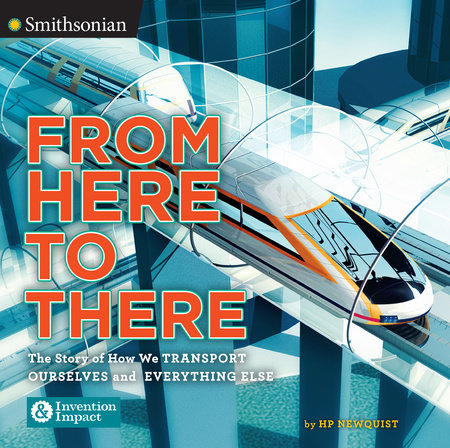


From Here to There

The Story of How We Transport Ourselves and Everything Else

This lively history of transportation follows our fascinating route from primitive technology like sandals to driverless cars and beyond!
 
Since humans first stood upright, we've been on the move. Need food? Water? Land? A place to live? Survival depends upon motion. For thousands of years, people have devised ways to move faster, farther, and more comfortably. Their inventions—shoes, skis, the rudder, the wheel, engines, rockets—have had an enormous impact on how and where human beings live and thrive.

When human beings get a move on, change happens:
- The wheel, probably first used in the Middle East around 6,000 years ago, meant building and trading supplies could be moved more easily—whole civilizations rolled out.
- The Vikings sailed far and wide because they used a keel on their longships.
- Horse-and-carriage gridlock gave rise to subways.
- The bicycle changed the world for women in terms of freedom and fashion.
- Drones and driverless cars are the future . . . coming sooner than we think.

Award-winning author HP Newquist explores the transportation inventions and technologies that have transformed the way we experience the world around us. It’s a fascinating journey!
HP Newquist is the author of more than a dozen nonfiction books, including Invention & Impact: The Human Body (Viking-Smithsonian); The Book of Chocolate (Viking Children's Books), The Book of Blood, a National Science Teachers Association Outstanding Science Book of the Year; the critically acclaimed The Great Brain Book, an NSTA and Children's Book Council Outstanding Science Book of the Year; and For Boys Only, an American Library Association "Quick Pick" and New York Public Library Best Book for the Teen Age, among others. His hundreds of magazine articles have appeared in publications such as The New York Times, USA Today, The Wall Street Journal, and Popular Science. View titles by HP Newquist
Praise for The Human Body by HP Newquist:

"The human body, for all of its amazing traits, is capable of breaking down, and this informative book covers both historical and modern innovations that help repair and strengthen it. . . the open page design and ample full-color photos and historical diagrams will easily draw in middle-grade readers, especially those looking for a more macabre look at history and science." —Booklist

"An effective approach, one that follows developments in medical innovation across the centuries. . . Numerous photographs and historical illustrations of current and past medical devices—including the gruesome tools once used for surgery and tooth extraction—provide fascinating detail and context." —The Horn Book

Accolades for HP Newquist:

NSTA Outstanding Science Book of the Year, The Great Brain Book and The Book of Blood
CBC Oustanding Science Book of the Year, The Great Brain Book
ALA "Quick Pick," For Boys Only

About

This lively history of transportation follows our fascinating route from primitive technology like sandals to driverless cars and beyond!
 
Since humans first stood upright, we've been on the move. Need food? Water? Land? A place to live? Survival depends upon motion. For thousands of years, people have devised ways to move faster, farther, and more comfortably. Their inventions—shoes, skis, the rudder, the wheel, engines, rockets—have had an enormous impact on how and where human beings live and thrive.

When human beings get a move on, change happens:
- The wheel, probably first used in the Middle East around 6,000 years ago, meant building and trading supplies could be moved more easily—whole civilizations rolled out.
- The Vikings sailed far and wide because they used a keel on their longships.
- Horse-and-carriage gridlock gave rise to subways.
- The bicycle changed the world for women in terms of freedom and fashion.
- Drones and driverless cars are the future . . . coming sooner than we think.

Award-winning author HP Newquist explores the transportation inventions and technologies that have transformed the way we experience the world around us. It’s a fascinating journey!

Author

HP Newquist is the author of more than a dozen nonfiction books, including Invention & Impact: The Human Body (Viking-Smithsonian); The Book of Chocolate (Viking Children's Books), The Book of Blood, a National Science Teachers Association Outstanding Science Book of the Year; the critically acclaimed The Great Brain Book, an NSTA and Children's Book Council Outstanding Science Book of the Year; and For Boys Only, an American Library Association "Quick Pick" and New York Public Library Best Book for the Teen Age, among others. His hundreds of magazine articles have appeared in publications such as The New York Times, USA Today, The Wall Street Journal, and Popular Science. View titles by HP Newquist

Praise

Praise for The Human Body by HP Newquist:

"The human body, for all of its amazing traits, is capable of breaking down, and this informative book covers both historical and modern innovations that help repair and strengthen it. . . the open page design and ample full-color photos and historical diagrams will easily draw in middle-grade readers, especially those looking for a more macabre look at history and science." —Booklist

"An effective approach, one that follows developments in medical innovation across the centuries. . . Numerous photographs and historical illustrations of current and past medical devices—including the gruesome tools once used for surgery and tooth extraction—provide fascinating detail and context." —The Horn Book

Accolades for HP Newquist:

NSTA Outstanding Science Book of the Year, The Great Brain Book and The Book of Blood
CBC Oustanding Science Book of the Year, The Great Brain Book
ALA "Quick Pick," For Boys Only