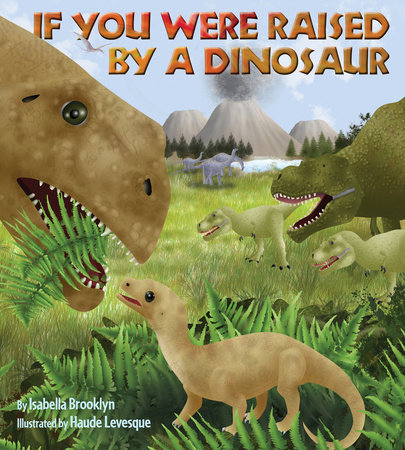
If You Were Raised by a Dinosaur

Illustrated by Haude Levesque
Look inside
Paperback
$9.95 US
9.16"W x 10.01"H x 0.29"D  
On sale Aug 01, 2013 | 80 Pages | 9781623540159
Grades 2-5
Reading Level: Lexile 1130L | Fountas & Pinnell R

What would it have been like to be a dinosaur baby long, long ago?

Every boy and girl dreams of seeing a dinosaur . . . but what about BEING one? Maybe a baby with Tyrannosaurus Rex as a mom? Or a gentler giant who preferred munching leaves? With lots of fascinating facts and striking illustrations that recreate a lost world millions of years old, Isabella Brooklyn and Haude Levesque guide young readers into the prehistoric era to find out.

Because scientists never had the chance to study a live dinosaur in its natural environment, they can't know for sure what kind of parents dinosaurs were, or exactly how they raised their young. But by following the clues they dig up, and using the latest in medical technology, paleontologists can make educated guesses, and offer an exciting glimpse into what it might have been like to be a dinosaur child.

Kids will meet dinosaurs of every type, from theropods and sauropodomorphs with their grasping, asymmetrical fingers to "good mother" Maiasaurus and Psittacosaurus babies who had "nannies"--adults that raised all the children in the group.

There's also a hint of what the future of dinosaur studies will be, thanks to technology unimaginable only a few years ago.
Isabella Brooklyn has loved dinosaurs since her first visit to the American Museum of Natural History. She spent many summers digging for dinosaur bones and settling for bottle caps, pennies, and once, a dead mouse. She lives outside of Philadelphia with her three children.
            People do it every day. So do birds, monkeys, butterflies, and platypuses. We have babies.
            For the 160 million years that the dinosaurs walked the earth, they did it, too.
            Every living animal reproduces in some way, but how each cares for its young differs from species to species. Humans buy them toys, create nurseries, and organize playdates. Birds built nests and sit patiently on their eggs to warm them with their own body heat. After the eggs hatch, the parents provide food and protection until the chicks are ready to take care of themselves. Sea turtles also build nests for their eggs. But once the eggs have been laid, the mother leaves them behind and never returns. The father sea turtle isn’t involved at all.
            It’s hard for paleontologists to know for sure how dinosaurs took care of their babies. After all, there are no living dinosaurs to observe in their natural environments. The only way scientists have to learn about dinosaurs and their parenting techniques is by studying the clues that have been left behind. But even this is easier said than done.
            The first dinosaurs appeared 230 million years ago, and the last to walk the earth were around until about 65 million years ago. That’s a really long time for fossils to wait to be excavated! Scientists have found lots of adult dinosaur bones, but the bones of young dinosaurs are harder to find. Their smaller, less-formed skeletons are easily damaged by trampling feet, geological shifts, or the jaws (and digestive systems) of hungry predators.
            Still, there are many things we have come to know—or at least think we know—about dinosaur mommies, daddies, and babies. But to understand all of this, we need to start at the beginning.

About

What would it have been like to be a dinosaur baby long, long ago?

Every boy and girl dreams of seeing a dinosaur . . . but what about BEING one? Maybe a baby with Tyrannosaurus Rex as a mom? Or a gentler giant who preferred munching leaves? With lots of fascinating facts and striking illustrations that recreate a lost world millions of years old, Isabella Brooklyn and Haude Levesque guide young readers into the prehistoric era to find out.

Because scientists never had the chance to study a live dinosaur in its natural environment, they can't know for sure what kind of parents dinosaurs were, or exactly how they raised their young. But by following the clues they dig up, and using the latest in medical technology, paleontologists can make educated guesses, and offer an exciting glimpse into what it might have been like to be a dinosaur child.

Kids will meet dinosaurs of every type, from theropods and sauropodomorphs with their grasping, asymmetrical fingers to "good mother" Maiasaurus and Psittacosaurus babies who had "nannies"--adults that raised all the children in the group.

There's also a hint of what the future of dinosaur studies will be, thanks to technology unimaginable only a few years ago.

Author

Isabella Brooklyn has loved dinosaurs since her first visit to the American Museum of Natural History. She spent many summers digging for dinosaur bones and settling for bottle caps, pennies, and once, a dead mouse. She lives outside of Philadelphia with her three children.

Excerpt

            People do it every day. So do birds, monkeys, butterflies, and platypuses. We have babies.
            For the 160 million years that the dinosaurs walked the earth, they did it, too.
            Every living animal reproduces in some way, but how each cares for its young differs from species to species. Humans buy them toys, create nurseries, and organize playdates. Birds built nests and sit patiently on their eggs to warm them with their own body heat. After the eggs hatch, the parents provide food and protection until the chicks are ready to take care of themselves. Sea turtles also build nests for their eggs. But once the eggs have been laid, the mother leaves them behind and never returns. The father sea turtle isn’t involved at all.
            It’s hard for paleontologists to know for sure how dinosaurs took care of their babies. After all, there are no living dinosaurs to observe in their natural environments. The only way scientists have to learn about dinosaurs and their parenting techniques is by studying the clues that have been left behind. But even this is easier said than done.
            The first dinosaurs appeared 230 million years ago, and the last to walk the earth were around until about 65 million years ago. That’s a really long time for fossils to wait to be excavated! Scientists have found lots of adult dinosaur bones, but the bones of young dinosaurs are harder to find. Their smaller, less-formed skeletons are easily damaged by trampling feet, geological shifts, or the jaws (and digestive systems) of hungry predators.
            Still, there are many things we have come to know—or at least think we know—about dinosaur mommies, daddies, and babies. But to understand all of this, we need to start at the beginning.