
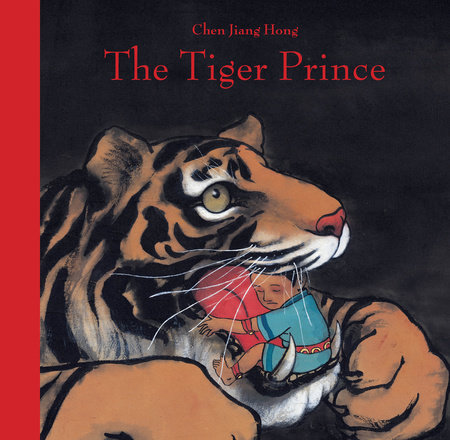

A magnificently illustrated Chinese folklore tale about a tigress, a seer, a King, and the prince, who must leave his family and learn the ways of the tigers so that the war between man and animal can end.

Deep in the Great Forest, a tigress is mourning the death of her tiger babies who have been killed by hunters. Seeking revenge, she attacks the villages, destroying houses and prompting the king to gather his army. But a seer named Lao Lao warns the king that if he angers the tigress further she will destroy the kingdom. Lao Lao counsels the king to give his own son to the tigress and promises that no harm will come to the boy. The next morning, the king brings the prince to the edge of the Great Forest and tells him, “Now you must go on alone.” To end the war between man and animal, the prince must forget his human ways and begin to learn what tigers know. The Tiger Prince was inspired by The Tigress, a late Shang dynasty bronze vessel in the Cernuschi Museum in Paris depicting a scene from the Chinese folktale of a baby raised by a tigress.
Chen Jiang Hong was born in Tianjin, China, where he studied fine art at the School of Arts before completing his postgraduate education at the China Central Academy of Fine Arts in Beijing. After graduating, he moved to Paris where he studied at the École des Beaux-Arts and began his career as an artist. His work has been exhibited around the world, notably at the library gallery at the Louvre, at the Centre Pompidou, and at Versailles. His work is in the permanent collection of the Snite Museum at the University of Notre Dame.

Alyson Waters has translated works from the French by Albert Cossery, Louis Aragon, René Belletto, and many others. For NYRB Classics, she translated Emmanuel Bove’s Henri Duchemin and His Shadows. She teaches literary translation in the French Department of Yale University and is the managing editor of Yale French Studies. She lives in Brooklyn.
"Chen's expressive brush paintings shift deftly between fearsome and warm, conveying the tigress's inner conflict using body language and expressions without anthropomorphizing her. Readers will recognize these characteristics and conflicts within themselves and realize that only bridges of compassion will truly build lasting peace. This richly illustrated tale is both emotionally compelling and thought-provoking, and its timely message of understanding and compassion will resonate with readers of all ages.” —Kirkus Reviews

"Two worlds collide in this epic Chinese folktale … [the] relationship that is built between man and beast over time will not only break the circle of violence but also teach us a thing or two about forgiveness, motherly love, trust, and friendship.” International Examiner 

About

A magnificently illustrated Chinese folklore tale about a tigress, a seer, a King, and the prince, who must leave his family and learn the ways of the tigers so that the war between man and animal can end.

Deep in the Great Forest, a tigress is mourning the death of her tiger babies who have been killed by hunters. Seeking revenge, she attacks the villages, destroying houses and prompting the king to gather his army. But a seer named Lao Lao warns the king that if he angers the tigress further she will destroy the kingdom. Lao Lao counsels the king to give his own son to the tigress and promises that no harm will come to the boy. The next morning, the king brings the prince to the edge of the Great Forest and tells him, “Now you must go on alone.” To end the war between man and animal, the prince must forget his human ways and begin to learn what tigers know. The Tiger Prince was inspired by The Tigress, a late Shang dynasty bronze vessel in the Cernuschi Museum in Paris depicting a scene from the Chinese folktale of a baby raised by a tigress.

Author

Chen Jiang Hong was born in Tianjin, China, where he studied fine art at the School of Arts before completing his postgraduate education at the China Central Academy of Fine Arts in Beijing. After graduating, he moved to Paris where he studied at the École des Beaux-Arts and began his career as an artist. His work has been exhibited around the world, notably at the library gallery at the Louvre, at the Centre Pompidou, and at Versailles. His work is in the permanent collection of the Snite Museum at the University of Notre Dame.

Alyson Waters has translated works from the French by Albert Cossery, Louis Aragon, René Belletto, and many others. For NYRB Classics, she translated Emmanuel Bove’s Henri Duchemin and His Shadows. She teaches literary translation in the French Department of Yale University and is the managing editor of Yale French Studies. She lives in Brooklyn.

Praise

"Chen's expressive brush paintings shift deftly between fearsome and warm, conveying the tigress's inner conflict using body language and expressions without anthropomorphizing her. Readers will recognize these characteristics and conflicts within themselves and realize that only bridges of compassion will truly build lasting peace. This richly illustrated tale is both emotionally compelling and thought-provoking, and its timely message of understanding and compassion will resonate with readers of all ages.” —Kirkus Reviews

"Two worlds collide in this epic Chinese folktale … [the] relationship that is built between man and beast over time will not only break the circle of violence but also teach us a thing or two about forgiveness, motherly love, trust, and friendship.” International Examiner 

Mental Health Awareness Month Resources

May is Mental Health Awareness Month and addressing student wellness and mental health is critical to help children learn how to manage emotions, develop healthy identities, empathize with peers, and pursue individual goals. We created thematic guides and book lists to help foster important conversations to build an inclusive environment where emotions matter. Explore our social emotional

Read more

Books for Asian American, Native Hawaiian, and Pacific Islander Heritage Month

Each May, we honor the stories, histories, and cultures of Asian Americans, Native Hawaiians, and Pacific Islanders. Below is a selection of acclaimed fiction and nonfiction books by AANHPI creators to share with your students this month and throughout the year. AANHPI Creators – Elementary School titles  

Read more