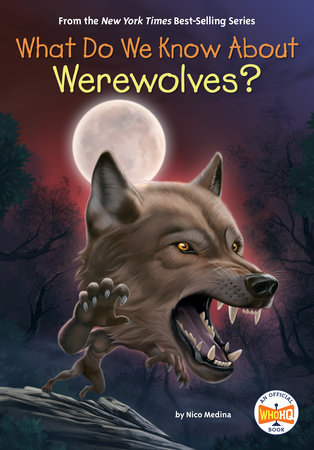
What Do We Know About Werewolves?

Illustrated by Manuel Gutierrez
Hardcover Library Binding
$15.99 US
5-7/16"W x 7-5/8"H
On sale Aug 04, 2026 | 112 Pages | 9798217141647
Grades 3-7

See Additional Formats
The What Do We Know About? series explores the mysterious, the unknown, and the unexplained. Is there a monstrous being that can shapeshift into a wolf during a full moon? Find out all we know about werewolves, wild transformations, silver bullets, and other facts that help us separate reality from legend in this exciting book!

Did you know that the first stories about werewolves date back to ancient Greece? For thousands of years, tales about people who can transform into wolves have entertained readers. But werewolves of the past were more than just folktales—many people believed that werewolves were real. One of the earliest known werewolf trials took place in 1428, when a person was accused of being a werewolf! Today, werewolves are frequently featured in movies, TV shows, and books. From the classic novel The Werewolf of Paris to Clawdeen Wolf of Monster High, there is no shortage of wolf-like characters to explore. But are werewolves simply a myth or do they actually roam the forests and woods to live alongside us? Find out before the next full moon.
© Nico Medina
Who HQ is your headquarters for history. The Who HQ team is always working to provide simple and clear answers to some of our biggest questions. From Who Was George Washington? to Who Is Michelle Obama?, and What Was the Battle of Gettysburg? to Where Is the Great Barrier Reef?, we strive to give you all the facts. Visit us at WhoHQ.com View titles by Who HQ
What Do We Know About Werewolves?

Nineteen eighty-two was the first year that an Academy Award was given for makeup in a motion picture. The famous award, more commonly known as an Oscar, went to Rick Baker. He had created the special effects for a movie called An American Werewolf in London.
Moviegoers were both shocked and mesmerized by one particular scene in the film, in which the main character—a college student who is bitten by a wolf—transforms into a wolflike monster in a most horrific manner. He screams as his hands and feet lengthen painfully into paws. Thick hair sprouts from his skin as his face extends into a twisting, snarling snout. Sharp claws sprout from the man’s fingertips. Audiences were wowed by how detailed the transformation was, and Rick Baker’s special effects made some people almost believe that werewolves could be real.

Ever since the first humans left their shelters to hunt and gather food, wolves have fascinated us. When people began keeping livestock, wolves—always looking for an easy meal—became our enemies. We eventually hunted them nearly to extinction in Europe. And yet still, we admired the wolf pack for what it was—a killer team, working together to survive—and, in some ways, we wanted to be like them.

Rick Baker had been making monsters all his life. The second mask that ten-year-old Rick made in 1960 was that of a Wolf Man, inspired by a classic movie. The special effects in 1941’s The Wolf Man were not as advanced as those in An American Werewolf in London. But at the time, the on-screen man-to-wolf transformation was impressive—even scary!

Surely, though, audiences understood these frightening scenes weren’t real. Werewolves and wolf men couldn’t truly exist. Could they?

Tales about people becoming wolves have been told—and believed—for almost as long as people have been telling stories. From ancient Mesopotamia to the Americas, classical Greek mythology to the Twilight Saga of the twenty-first century.

In early human history, werewolf tales may have been created to help make sense of our world.

Today, we mostly tell them to give people a good scare at the movies.

About

The What Do We Know About? series explores the mysterious, the unknown, and the unexplained. Is there a monstrous being that can shapeshift into a wolf during a full moon? Find out all we know about werewolves, wild transformations, silver bullets, and other facts that help us separate reality from legend in this exciting book!

Did you know that the first stories about werewolves date back to ancient Greece? For thousands of years, tales about people who can transform into wolves have entertained readers. But werewolves of the past were more than just folktales—many people believed that werewolves were real. One of the earliest known werewolf trials took place in 1428, when a person was accused of being a werewolf! Today, werewolves are frequently featured in movies, TV shows, and books. From the classic novel The Werewolf of Paris to Clawdeen Wolf of Monster High, there is no shortage of wolf-like characters to explore. But are werewolves simply a myth or do they actually roam the forests and woods to live alongside us? Find out before the next full moon.

Author

© Nico Medina
Who HQ is your headquarters for history. The Who HQ team is always working to provide simple and clear answers to some of our biggest questions. From Who Was George Washington? to Who Is Michelle Obama?, and What Was the Battle of Gettysburg? to Where Is the Great Barrier Reef?, we strive to give you all the facts. Visit us at WhoHQ.com View titles by Who HQ

Excerpt

What Do We Know About Werewolves?

Nineteen eighty-two was the first year that an Academy Award was given for makeup in a motion picture. The famous award, more commonly known as an Oscar, went to Rick Baker. He had created the special effects for a movie called An American Werewolf in London.

Moviegoers were both shocked and mesmerized by one particular scene in the film, in which the main character—a college student who is bitten by a wolf—transforms into a wolflike monster in a most horrific manner. He screams as his hands and feet lengthen painfully into paws. Thick hair sprouts from his skin as his face extends into a twisting, snarling snout. Sharp claws sprout from the man’s fingertips. Audiences were wowed by how detailed the transformation was, and Rick Baker’s special effects made some people almost believe that werewolves could be real.


Ever since the first humans left their shelters to hunt and gather food, wolves have fascinated us. When people began keeping livestock, wolves—always looking for an easy meal—became our enemies. We eventually hunted them nearly to extinction in Europe. And yet still, we admired the wolf pack for what it was—a killer team, working together to survive—and, in some ways, we wanted to be like them.

Rick Baker had been making monsters all his life. The second mask that ten-year-old Rick made in 1960 was that of a Wolf Man, inspired by a classic movie. The special effects in 1941’s The Wolf Man were not as advanced as those in An American Werewolf in London. But at the time, the on-screen man-to-wolf transformation was impressive—even scary!

Surely, though, audiences understood these frightening scenes weren’t real. Werewolves and wolf men couldn’t truly exist. Could they?

Tales about people becoming wolves have been told—and believed—for almost as long as people have been telling stories. From ancient Mesopotamia to the Americas, classical Greek mythology to the Twilight Saga of the twenty-first century.

In early human history, werewolf tales may have been created to help make sense of our world.

Today, we mostly tell them to give people a good scare at the movies.

Mental Health Awareness Month Resources

May is Mental Health Awareness Month and addressing student wellness and mental health is critical to help children learn how to manage emotions, develop healthy identities, empathize with peers, and pursue individual goals. We created thematic guides and book lists to help foster important conversations to build an inclusive environment where emotions matter. Explore our social emotional

Read more

Books for Asian American, Native Hawaiian, and Pacific Islander Heritage Month

Each May, we honor the stories, histories, and cultures of Asian Americans, Native Hawaiians, and Pacific Islanders. Below is a selection of acclaimed fiction and nonfiction books by AANHPI creators to share with your students this month and throughout the year. AANHPI Creators – Elementary School titles  

Read more