
Where Is South Carolina?
During the Revolutionary War, American colonists learned that British troops planned to attack Charleston (say: CHARL-stun). It was an important port city where people and goods—including soldiers and weapons—could be shipped across the ocean. It was also the capital of South Carolina, one of the thirteen colonies that had declared independence from Britain.

The Continental Army needed a fort to protect Charleston. They hurried to build one on Sullivan’s Island, at the entrance to the harbor. The colonists cut thousands of palmetto trees to make the fort’s log walls. Palmetto trees, also called sabal palms, are common in the area. They can grow along the coast or in ponds of brackish (a mix of salt and fresh) water, so there were many of them on Sullivan’s Island. To survive windy weather and hurricanes, palmettos have flexible, bendy wood. Colonists filled the space between the log walls with sand.
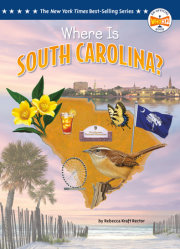
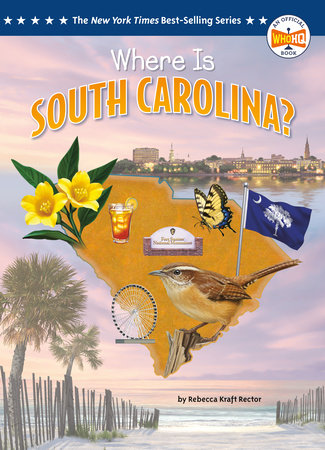
They had only managed to build two walls when British ships arrived on June 28, 1776. The nine enemy ships carried almost three hundred cannons. The British bombarded the half-built fort for more than ten hours. But the palmetto walls didn’t shatter when cannon balls struck. Because they were so flexible, they absorbed the impact. British ships were damaged when the colonists returned fire. The British withdrew, giving the colonists their first major victory in the Revolutionary War. Today, South Carolina’s state flag and state seal each feature a palmetto tree.
Copyright © 2026 by Penguin Random House LLC. All rights reserved. No part of this excerpt may be reproduced or reprinted without permission in writing from the publisher.